
For Google AI results, do the durable SEO work. For broader AI visibility, also manage entity facts, crawler access, outside proof, and source consistency.
- Google AI search
- AEO and GEO
- AI search optimization
- AI Overviews
- AI visibility strategy
The market is full of AI search shortcuts. Google just gave business teams a cleaner way to decide what deserves budget and what can wait.
Google's AI search guide points teams back to pages people can use and trust: accessible to crawlers, supported by relevant media, and kept current as the facts change.
Google Search is still only part of the AI answer market. Chat search, browser and shopping agents, reviews, directories, documentation, and community language can all shape how a system describes a business. Start with SEO, then strengthen the proof around it.
Is AEO or GEO different from SEO for Google AI search?
For Google AI search, AEO and GEO are not separate systems with secret rules. Google Search Central from Google (GOOGL) published a new guide on May 15, 2026, and its direct answer is simple: optimizing for generative AI features in Google Search is still optimizing for the search experience.
Google says AI Overviews and AI Mode are rooted in core Search ranking and quality systems. The guide also explains that these features use retrieval augmented generation and query fan out. In plain terms, Google can run related searches, pull from its index, inspect specific pages, and show links that support the answer.
Earn a place in the search index with useful answers and pages the system can process. Support those answers with evidence. Google does not prescribe a secret file format or a special prose style for bots.
What should businesses stop doing after Google's AI search guide?
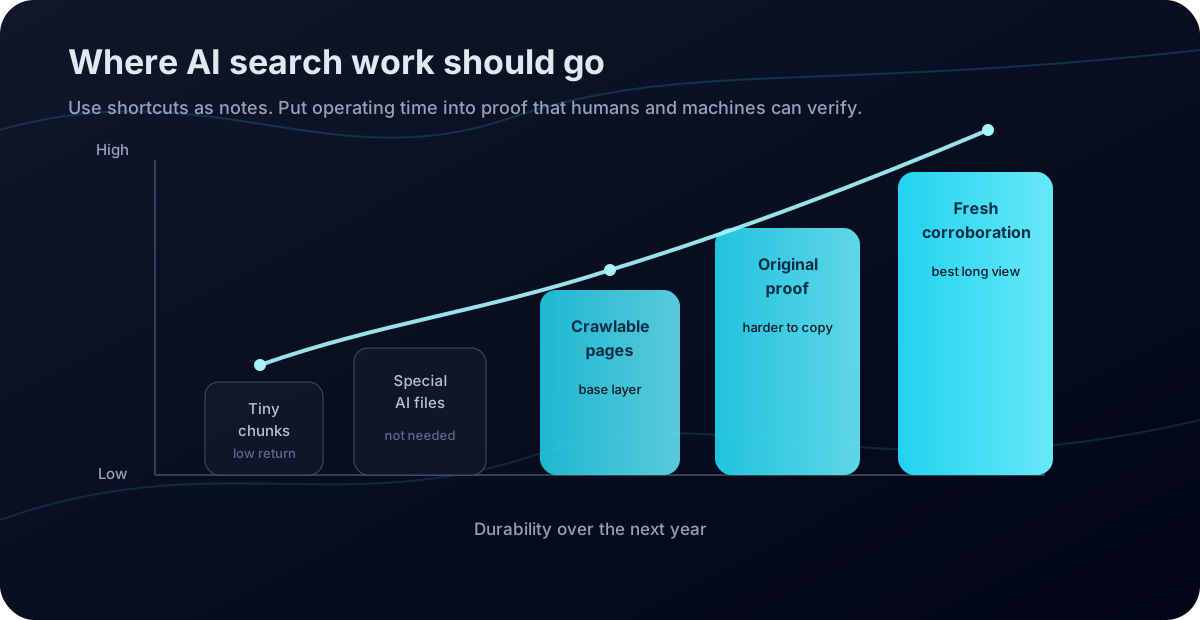
Businesses should stop treating Google AI visibility as a shortcut market. Google says there is no need to create new machine readable AI files, special AI text files, special markup, or Markdown files to appear in Google generative AI features. It also says there is no required content chunk size and no special schema type for generative AI search.
Keep the claim narrow: llms.txt, tiny content chunks, and synthetic mention campaigns are not required Google AI Search work. That does not settle whether an experimental file has a use in some other system.
Community discussions this week show why the guide matters. Operators are tired of vague AEO packages, fake mention schemes, and page factories built around every possible prompt. The guide gives a cleaner budget test: if the tactic does not help users, crawl access, source quality, or public proof, it should not be the first thing funded.
What should teams keep doing for Google AI visibility?
Teams should keep doing the SEO work that makes a site useful and understandable. That means original content, clear sections, crawlable pages, internal links, text that carries the important facts, useful images and video when they help the page, and structured data that matches visible content.
Google also says pages need to meet Search technical requirements and be eligible to appear with a snippet. Indexing is still not guaranteed. Serving is still not guaranteed. That line matters because AI visibility work often gets sold as a control knob. It is not. It is a readiness practice.
| Workstream | What Google says | Business action |
|---|---|---|
| Helpful content | Original, useful, expert led pages matter more than copied summaries. | Publish experience, examples, data, cases, and clear answers buyers need. |
| Crawl access | AI features rely on publicly accessible, crawlable content from Search. | Check robots rules, CDN rules, status codes, canonical tags, and sitemap coverage. |
| Structured data | No special AI schema is required, but normal schema can still help Search features. | Use Article, Organization, Product, LocalBusiness, FAQ, or review markup only when accurate. |
| Media | Images and video can be pulled into AI search experiences when relevant. | Add useful visuals with descriptive alt text, filenames, captions, and surrounding context. |
| Measurement | AI feature clicks are included in Search Console Web search reporting. | Track Search Console, analytics, conversions, prompt tests, and cited source patterns together. |
Why does strong Google SEO still not guarantee AI visibility everywhere?
Strong Google SEO does not guarantee visibility in every AI answer system because each system has its own crawl rules, source mix, retrieval behavior, product surface, and safety policy. Google Search, ChatGPT search, browser agents, shopping agents, and internal business assistants do not all gather evidence the same way.
OpenAI's crawler documentation is a useful example. It separates OAI SearchBot for search from GPTBot for training related crawling and ChatGPT User for user requested actions. A site can allow one and block another. That means a business cannot reduce AI visibility planning to one Google checklist.
This is where AEO and GEO still have practical meaning outside Google's narrow framing. Use those labels for the broader work: entity clarity, citation readiness, source consistency, crawler policy, public proof, and prompt testing across the systems that matter to the business. Just do not confuse the broader program with Google specific ranking levers.

How should a business build the citation environment?
A business should build the citation environment by making sure trustworthy sources outside one article support the same facts. Owned pages matter, but AI systems also look at docs, reviews, directories, videos, forums, product feeds, profile pages, business listings, press, support pages, and standards based records depending on the category.
Start with facts that should never drift: company name, product names, service area, address, phone, support links, pricing model, shipping rules, return rules, warranty terms, integrations, compliance claims, and customer proof. Then check whether those facts match across public places. If the site says one thing and reviews or directories say another, an answer system has ambiguity.
Use actual customer concerns to guide the content: setup time, support delays, policy limits, review quality, delivery windows, and total cost. Answer them directly and consistently. Google warns against manufacturing mentions to simulate that support.
What does agent ready website work add to AI search planning?
Agent ready website work adds the next layer after search visibility. Google points readers to web.dev's agent friendly website guidance because browser agents may inspect screenshots, the DOM, and the accessibility tree. That matters for forms, product pages, checkout, booking, support flows, and account tasks.
The agent friendly checklist is practical: stable layout, semantic buttons and links, clear labels, visible actions, useful names and roles, and fewer confusing overlays. That is not only for agents. It also helps people using assistive technology, buyers on mobile, and teams trying to reduce broken conversion paths.
This is a good bridge between SEO and agentic commerce. Search systems need to understand the page. Agents need to act on it. If the page is readable but the form has hidden controls, unclear buttons, shifting layouts, or missing labels, visibility may improve while agent completion still fails.
How should teams measure Google AI search without overclaiming?
Teams should measure Google AI search as part of Search performance, not as a fully separated channel. Google says AI Overviews and AI Mode clicks are included in Search Console under Web search reporting. It also recommends looking at conversions and time on site in other tools.
That creates a measurement limit. A business may not get a clean line item for every AI Overview or AI Mode impression. Do not invent precision the tools do not provide. Instead, combine Search Console, analytics, conversion data, page level changes, prompt tests, and cited source tracking.
Compare this quarter's important answers with last quarter's. Are they easier to find and cite, and is the evidence stronger? That question gives the team something it can inspect and improve.
What should the next quarterly AI visibility sprint include?
A quarterly AI visibility sprint should update the public record, not just publish more posts. Pick the highest value questions buyers ask before they contact sales, book a service, compare a product, or trust a business. Then make the answers easier to verify.
- Check whether important pages are indexed, crawlable, internally linked, and present in the sitemap.
- Rewrite thin pages with real experience, examples, limits, proof, and current buyer language.
- Make the first screen answer the main question instead of delaying the point.
- Clean up Organization, Article, Product, LocalBusiness, FAQ, and review markup where it matches visible content.
- Compare owned claims against reviews, directories, customer support themes, docs, videos, and public profiles.
- Test buyer prompts in Google Search, Google AI features, ChatGPT search, and any AI tools that send real traffic.
- Record which sources appear, which sources conflict, and which high value questions are still unanswered.
- Improve agent ready UX for forms, product flows, booking steps, and support actions.
How does this connect to prior Deploy Agentic AI visibility work?
This post narrows the Google question. For a broader plan, read our guide to AI visibility strategy, then use the AI crawler access audit to check whether important pages are reachable. If leadership needs a measurement model, use AI visibility ROI measurement to track prompts, citations, AI referral traffic, and assisted pipeline without overstating causality.
Ecommerce and product teams should also review agent ready product data. The same public proof layer that helps AI search understand a product can help shopping agents compare products, policies, and support terms later.
FAQ
Is AEO dead because Google says it is still SEO?
No. AEO is still a useful label for answer ready content and measurement. It is just not a separate Google ranking system with secret requirements. Treat it as a practical program, not a shortcut product.
Should businesses delete llms.txt?
Not automatically. Google says llms.txt is not needed for Google generative AI search. Other AI tools may still read it or use it as a guide. Keep it only if it points to useful public sources and you can maintain it.
Does structured data help with Google AI search?
Structured data is not required for Google generative AI search and there is no special AI schema. It can still help normal Search features when it matches visible page content and follows Google guidelines.
What is the fastest useful action?
Pick one money page and audit it from the answer backward. Check whether it answers the main buyer questions in the first screen, is crawlable, has clear internal links, uses accurate structured data, and matches outside public proof.
Bottom line
Google's May 15 guide should reduce the noise around AEO and GEO. For Google Search, the foundation is still useful content, crawl access, technical clarity, media, links, and policies that match the visible page. Special AI files, forced chunks, and fake mentions are not the core plan.
The broader AI visibility plan still matters. Businesses need a public proof layer that stays current across owned pages, reviews, directories, docs, support content, product data, and crawler policies. That is how search engines, answer engines, agents, and buyers get a clearer answer.
Sources
- Google Search Central, May 15, 2026: Optimizing your website for generative AI features on Google Search
- Google Search Central: AI features and your website
- web.dev, April 1, 2026: Build agent friendly websites
- OpenAI developer documentation: Overview of OpenAI crawlers
- Google Search Central: Creating helpful, reliable, people first content
- Google Search Central: Guidance on AI generated content
- Schema.org: Article type
- Schema.org: FAQPage type
If your AI visibility plan is mostly tricks, it is time to rebuild it around proof.
Deploy Agentic helps business teams audit crawl access, answer quality, entity consistency, structured data, agent ready UX, and public proof so AI systems can understand the business without guessing.
Talk With Deploy Agentic