
Agent ready product data means your public product facts are clear enough for an AI system to read, compare, cite, and act on without guessing.
- agent ready product data
- AI shopping agents
- agentic commerce catalog readiness
- product structured data
- AI commerce SEO
Payment protocols are getting attention, but most businesses still need to fix the product, policy, and proof layer that agents depend on before checkout.
Preparing for AI shopping starts with the product page, not a payment protocol. Does the page explain what the product is, what it costs, whether it is available, who it suits, where its limits are, and what happens after the sale?
Next, compare that answer with the feed, structured data, support pages, reviews, and directory listings. Contradictions force the agent to guess, and visibility, trust, and conversion begin to break at exactly that point.
What is agent ready product data?
Agent-ready product data is product information that AI shopping agents can retrieve, understand, compare, cite, and use inside a buying task. It includes visible product page content, structured data, merchant feeds, product identifiers, pricing, availability, shipping, returns, warranty terms, support rules, reviews, and outside proof.
A business is agent-ready when its product facts are current, crawlable, structured, and consistent wherever an AI system is likely to check. Strong Google SEO helps, but cannot guarantee AI visibility. AI tools also need entity clarity, clean evidence, and enough corroboration to trust the answer.
This matters now because agentic commerce has moved from theory to operating planning. McKinsey's October 2025 agentic commerce report says the United States business to consumer retail market could see up to one trillion dollars in orchestrated revenue from agentic commerce by 2030, with global projections reaching three trillion to five trillion dollars. That does not mean every business should redesign checkout this quarter. It does mean the product proof layer deserves attention before agents become a material channel.
Why should businesses fix product data before agent checkout?
A payment integration cannot fix a catalog that describes the wrong item. Stale stock, an ambiguous variant, or a buried policy can send an agent toward the wrong purchase or a seller whose facts are easier to verify. Get the product record straight before adding another way to pay.
OpenAI and Stripe made agent checkout more concrete in September 2025 with Instant Checkout and the Agentic Commerce Protocol. Google framed the permission side through AP2, where the system needs evidence of user intent, cart contents, and payment authority. Those protocol moves are important, but a protocol cannot rescue a weak catalog.
An AI agent still has to answer basic buyer questions. Is this the right model? Is it in stock? Does it fit the use case? What is included? Can it be returned? Are reviews consistent with the claim? Is the seller the actual seller? Is the support page current? Those are not search engine tricks. They are operating facts.
What product facts do AI shopping agents need first?
AI shopping agents need the same facts a careful buyer needs, but in a cleaner and more reusable form. Start with the product name, category, images, identifiers, variants, price, availability, shipping, return terms, warranty, compatible use cases, and support path.
Google Search Central's Product structured data documentation is a useful baseline because it explains the difference between product snippets and merchant listings. Product snippets help with pages where people cannot directly buy. Merchant listings apply to pages where customers can buy from you and can include richer details such as shipping, return policy, and product specifics.
Reconcile the page and the data against what you can actually fulfill. Free returns on the product page cannot mean store credit in the policy. In stock in the feed cannot mean back order on the page. A review profile should describe the same service area as the website.
How should structured data and feeds work together?
Structured data and feeds should work together as two views of the same product truth. Structured data helps crawlers understand the visible page. Merchant feeds help platforms verify product attributes at scale. When both are present and consistent, the business gives search systems and AI systems more reasons to trust the product record.
Google says product data can be provided through Product structured data on pages, through Merchant Center feeds, or both. It also says that providing both can maximize eligibility and help Google correctly understand and verify data. That is a useful model for AI readiness beyond Google. Agents work better when the same facts can be checked from multiple legitimate surfaces.
For physical products, product identifiers matter. GS1's Digital Link standard connects identifiers like GTINs to online product information. That kind of stable identity is useful because AI systems need to know whether two pages describe the same product, a variant, a bundle, or a substitute.

What should policy pages say for AI shopping agents?
Policy pages should answer the purchase questions an agent needs before it can recommend or buy: shipping cost, delivery timing, returns, refund method, warranty, cancellation, subscription terms, support hours, geographic limits, and any special restrictions. The policies should be readable on normal pages, not hidden only inside checkout screens.
This is not only an SEO issue. It is also an evidence issue. If an agent buys a product and the buyer later objects, the business needs to show what policy was available at the time. The cleaner the public policy record, the easier it is for an answer engine, a buyer, a support team, or a payment reviewer to understand what happened.
Write policy pages in buyer language. Community discussions around agentic commerce keep coming back to blunt questions: can the bot be trusted with my card, what if it buys the wrong thing, who pays when it makes a bad call, and how does a merchant prove the order was real? Those are the questions policy pages should answer in normal words.
How does this connect to AEO and GEO?
AEO and GEO connect to product data because AI answers are built from retrievable evidence. A page can rank in Google and still be weak for AI if the entity is unclear, the product facts are incomplete, the policy details are stale, or outside sources contradict the owned site.
For answer engine optimization, each major section should answer a real buyer question directly. What is included? Who is this for? What are the limits? What happens if it fails? How does the return work? For generative engine optimization, the same answers need enough structure and proof that an AI tool can extract them without turning them into a vague summary.
This is why entity clarity matters. Use consistent organization names, product names, addresses, phone numbers, support pages, author or publisher details, and profile links. If the site says one company name, the directory says another, and the reviews use a third, the model has ambiguity. That ambiguity can reduce citation confidence.
What source environment will AI tools trust for product claims?
AI tools are likely to trust a mix of source types depending on the product category. For normal commerce claims, the strongest environment usually includes official product pages, current policy pages, structured data, merchant feeds, developer or support docs where relevant, reviews, directories, case studies, standards based identifiers, and credible third party references.
Owned content is necessary, but it is not enough by itself. A product page can say the product is durable, fast, compliant, or easy to return. An AI system gets more confidence when reviews, support docs, directory profiles, product identifiers, and public case studies do not fight that claim.
Use customer questions to find the gaps in that record. If reviews and support conversations keep mentioning setup time, replacement parts, compatibility, delivery windows, or cancellation problems, address those points plainly. Consistent facts need not sound like copied brand boilerplate.
Should businesses update robots rules and llms.txt?
Businesses should review robots rules and crawler access before treating AI shopping as a channel. If important product and policy pages are blocked, heavily scripted, missing from the sitemap, or only visible after a login, AI systems may not be able to retrieve the facts needed for an answer.
OpenAI publishes crawler documentation for user agents such as OAI SearchBot and ChatGPT User. Google also maintains crawler and AI feature guidance across Search Central. The practical work is to choose which bots and search systems the business wants to support, make the allowed pages accessible, and test whether the actual rendered content can be read.
llms.txt can be useful as a guide that points AI systems toward key pages, docs, and policy sources, but it is not a substitute for accessible public pages. Treat it as a map, not the building. Keep it current if you use it.
How should businesses audit agent ready product data?
Businesses should audit agent ready product data by tracing one product from buyer question to public proof. Pick a high value product or service and ask what an AI shopping agent would need to know before recommending it.
Start with ten real buyer prompts. Use practical wording, not internal category names. Ask for comparisons, budget limits, timing constraints, compatibility questions, policy questions, and support concerns. Record which pages and sources answer those questions cleanly. Then check whether your product page, feed, structured data, review profile, and support docs agree.
The audit should end with a fix list, not a report that sits in a folder. Update page copy where facts are missing. Correct feed mismatches. Add structured data where it reflects visible content. Clean up stale policy pages. Improve public support docs. Add or update case studies when real outcomes can be stated clearly.
What does a quarterly refresh look like?
Treat the quarterly refresh as catalog maintenance. Check whether the public record still matches the business as products, policies, reviews, platform documentation, and AI answers change.
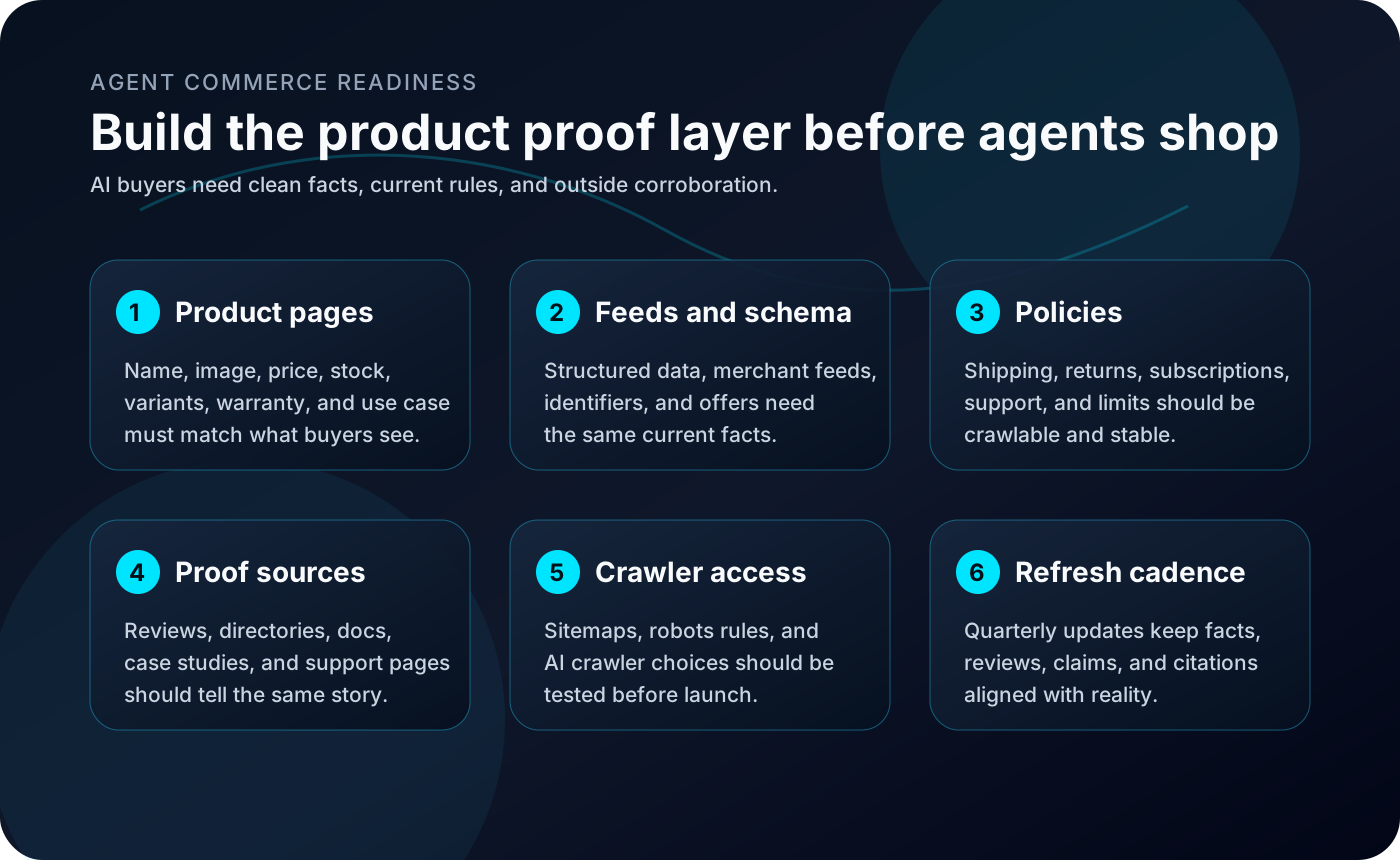
A practical refresh has six parts. Review top product pages. Compare page facts with structured data and feeds. Check policy pages for stale details. Test crawler access and sitemap coverage. Search the web for contradictory third party claims. Run buyer prompts in the AI tools that matter to the business and record which sources they cite.
Keeping those records current gives buyers a firmer basis for a decision and AI systems clearer evidence to cite. The value comes from maintaining the facts, not from a one-time rewrite.
The agent ready product data checklist
Use this checklist before treating AI shopping agents as a real acquisition channel.
- Make product names, categories, images, and identifiers consistent across pages and feeds.
- Keep price, availability, variants, bundles, subscriptions, and delivery timing current.
- Use Product, Offer, Organization, FAQ, shipping, and return policy markup only where it matches visible content.
- Publish plain language policy pages for shipping, returns, warranty, cancellation, support, and limits.
- Make important product and policy pages crawlable, linked, and present in the sitemap.
- Review robots rules and AI crawler choices so important public facts are not blocked by accident.
- Use llms.txt only as a guide to the best public sources, not as a replacement for real pages.
- Align review profiles, directories, case studies, support docs, and owned product claims.
- Test real buyer prompts and note which sources AI tools use in answers.
- Refresh the proof layer every quarter or whenever a major product, policy, or channel changes.
FAQ
Is agent ready product data just structured data?
No. Structured data is one part of it. Agent ready product data also includes visible page content, merchant feeds, policy pages, support docs, reviews, directories, source accessibility, and freshness.
Does every business need agent checkout right now?
No. Many businesses should start with discovery readiness and proof readiness. Let AI systems understand the product, cite the right pages, and route buyers to accurate next steps before pushing for autonomous purchase flows.
What is the fastest first step?
Audit one important product. Compare the product page, structured data, feed, policy pages, reviews, and support docs. If those sources disagree, fix that before adding more AI content.
Can AI tools use reviews and community language?
Yes, depending on access and source quality. Reviews and community language can help AI tools understand what buyers actually care about. Businesses should not copy that language blindly, but they should use it to answer real objections in clear public content.
Bottom line
Agent ready product data lets a shopping agent establish what you sell, which terms apply, and what supports the claim. If those answers disagree across sources, start by fixing the disagreement.
The practical work is plain: clean product pages, consistent feeds, accurate structured data, crawlable policies, outside proof, and a quarterly refresh habit. That work helps search engines, answer engines, AI agents, support teams, and buyers at the same time.
Sources
- McKinsey, October 17, 2025: The agentic commerce opportunity
- McKinsey, February 2026: The automation curve in agentic commerce
- Google Search Central: Product structured data
- Google Search Central: Product snippet structured data
- OpenAI, September 29, 2025: Instant Checkout and Agentic Commerce Protocol
- Stripe, September 29, 2025: Instant Checkout in ChatGPT
- Google Cloud, September 16, 2025: Agent Payments Protocol
- OpenAI developer documentation: Overview of OpenAI crawlers
- Schema.org: Product type
- Schema.org: Offer type
- GS1: Digital Link standard
If agents are going to evaluate your products, your proof layer needs to be readable.
Deploy Agentic helps business teams clean up product facts, policy pages, AI crawl access, structured data, and outside corroboration so AI systems can understand the business without guessing.
Talk With Deploy Agentic