
AI tools cannot explain your business well if the best proof is blocked, buried, or stale.
- AI crawler access audit
- AI crawler access
- AI visibility audit
- answer engine optimization
- generative engine optimization
Teams keep writing more content before checking whether AI systems can reach and trust the proof.
Before building a large content calendar for AI visibility, check whether answer systems can reach and read the public pages that already prove the business.
A strong article, case study, pricing page, or documentation page cannot help if search crawlers, AI search bots, user-requested fetchers, or hosting rules keep it out of the answer path.
What is an AI crawler access audit?
An AI crawler access audit checks whether answer systems can reach, parse, and verify the public pages that explain a business. It starts with robots.txt, but it does not stop there. It also checks CDN rules, hosting blocks, server status codes, internal links, readable text, structured data, outside corroboration, and proof freshness.
Access is the first gate in AI visibility. Clever copy cannot force an answer engine to use a blocked or unreadable page. A reachable page can still be skipped when its facts are vague or unsupported.
Google says its AI features use the same broad SEO foundations as Search. The page must be indexed and eligible to show a snippet, and Google specifically points site owners to crawler access through robots.txt, CDN settings, internal links, textual content, structured data that matches the visible page, and current business details. OpenAI and Anthropic now document separate crawlers or user agents for search, user requested access, and model training. That separation is the practical reason this audit matters.
Why can good pages still fail inside AI answers?
A page can pass one test and fail the next. Robots rules may allow it while the CDN blocks it. A successful response may still contain little readable text. And a clear page may conflict with an old directory listing or review. Check access, extraction, and evidence separately.
Treat access as a diagnostic step before assuming you need a larger content calendar. Sometimes the missing piece is more material. Sometimes it is a firewall rule, a claim trapped in a graphic, or conflicting descriptions of the service and audience.
The useful operating lesson is this: ranking well in Google does not guarantee visibility in AI answers. That is not because SEO stopped mattering. It is because answer systems need more than one strong page. They need an accessible page, a clear entity, and enough outside support to avoid guessing.

Which AI crawler rules should business teams review?
Review each major crawler by purpose, not just by brand. The useful split is search visibility, user requested browsing, ad or safety checks where relevant, and model training. A single broad block can have different consequences depending on the provider.
OpenAI documents OAI SearchBot for search visibility in ChatGPT search features, GPTBot for model training, and ChatGPT User for certain user actions. OpenAI says those settings are independent. A site can allow the search bot while disallowing the training bot. That is the pattern business teams should understand before they copy a generic block list.
Anthropic documents Claude SearchBot for search result quality, Claude User for user requested retrieval, and ClaudeBot for model training data collection. Its help page says disabling search or user requested access can reduce visibility or retrieval when a user asks for content. Again, the point is not that every business should allow everything. The point is that every business should decide deliberately.
Google handles AI features in Search through normal Googlebot access and existing Search controls. Google also points to Google Extended for limiting training and grounding in some other Google systems. The practical lesson is the same: do not assume one robots line controls every AI use case.
Is robots.txt enough for AI visibility?
Robots.txt is necessary, but it is not enough. The Robots Exclusion Protocol gives service owners a standard way to tell crawlers which content may be accessed. It is the right place to review user agents and path rules. It is not a full visibility system.
A crawler can be allowed in robots.txt and still fail because the CDN blocks it, the server returns errors, the page relies on client side rendering that hides important facts, internal links do not expose the page, or the content is so vague that it gives the answer system nothing useful to extract.
Cloudflare made this distinction clear in its September 24, 2025 Content Signals Policy launch. It describes robots.txt as a way to control access, then adds that content signals are preferences about use after access. It also notes that some bots obey robots.txt and some do not. That is why this audit should look at both policy and observed behavior.
Should you use llms.txt?
You can test llms.txt, but do not treat it as the main fix. The practical role is to point AI systems toward important content in a simpler format. The risk is pretending that a new text file solves crawl access, source quality, structured data, or public proof.
Google explicitly says site owners do not need to create new AI text files or special markup to appear in its AI features. That does not mean every other system will ignore llms.txt forever. It means the durable foundation is still crawlable pages, clear text, internal links, accurate structured data, and corroboration.
The best use is modest. Add it only if it helps your team keep a clean index of the pages that matter most: service pages, documentation, public case studies, pricing explainers, policy pages, and high value articles. Then keep it current. A stale access file can create another source of confusion.
What should the audit check on each important page?
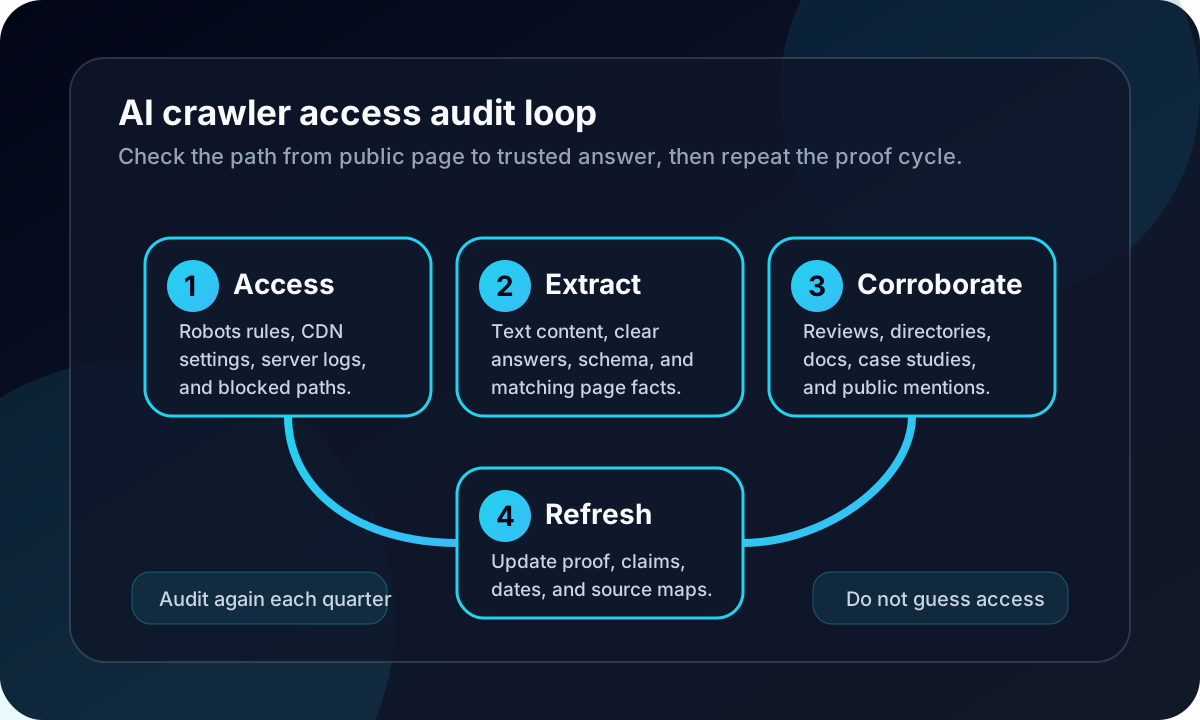
Each important page should pass four tests: access, extraction, entity clarity, and proof. If it fails one, fix that layer before judging the content strategy.
Access means the page returns a clean status, is not blocked by robots.txt for the systems you want to reach, is not blocked by CDN or firewall rules, appears in the sitemap where appropriate, and is linked from a logical place on the site.
Extraction means the important answer exists in visible text. Do not hide the only useful claim inside an image, animation, script only component, or vague headline. AI systems need text they can quote, summarize, and compare.
Entity clarity means the page makes the business easy to identify. It should say who the company serves, what it does, where it operates if location matters, what category it belongs to, and what proof supports the claim.
Proof means the page is backed by public evidence. Reviews, directories, customer stories, technical docs, support pages, partner mentions, and credible community language should not all point in different directions.
How do you check crawl access without guessing?
Check crawl access from the outside in. Start with the public URL, then walk back through the rules that can stop a crawler before it reaches the content.
First, fetch the page and confirm the status code. Important public pages should not return intermittent errors, soft error pages, login walls, or region blocks. Then review robots.txt for the relevant user agents and path rules. Confirm the sitemap points to the page and that internal links make the page discoverable.
Next, check CDN, hosting, security, and firewall settings. This step matters because Google specifically tells site owners to ensure crawling is allowed not just in robots.txt, but also by CDN or hosting infrastructure. Operators in community discussions keep running into this exact problem: the robots file says allow, but the edge layer still blocks or challenges the crawler.
Finally, review server logs where you can. Look for search bots, AI user agents, blocked responses, request spikes, and update timing. Logs do not prove citation, but they show whether access is happening at all.
How should public proof be aligned for AI answers?
Public proof should be aligned around the real customer language, not forced into sterile brand copy. Answer systems can handle natural wording. They struggle when the public record says several conflicting things about the same company.
A useful citation environment map includes source types that AI tools are likely to trust for your category. For a software company, that may include product documentation, review sites, integration pages, trusted directories, public changelogs, case studies, and credible technical discussions. For a local or service business, it may include business profiles, reviews, service pages, industry directories, public projects, location details, and helpful community references.
Real community language often surfaces better buyer questions than keyword tools. Use that language to shape headings, examples, and objections. Do not paste it into public copy. Translate it into plain, accurate answers that a buyer would recognize.
What does freshness have to do with crawler access?
Freshness matters because crawler access is not a one time setting. Provider documentation changes, user agents change, CDN products change, old pages decay, and outside proof gets stale. A rule that made sense six months ago can quietly block the source you now want AI search to use.
Review the audit quarterly for priority pages. Check robots.txt, sitemap entries, structured data, visible page claims, source dates, review language, directory details, and case study numbers. If your business changed its offer, audience, location, pricing, or proof, the public record should change too.
Keep recurring checks on the facts that change. Publishing more pages will not repair an outdated offer or a conflicting business profile. The business should be described accurately beyond its own homepage.
What should you fix first after an AI crawler access audit?
Fix the highest impact block first. If a core page is unreachable, fix access. If it is reachable but hard to extract, rewrite the first section and add visible answer text. If the page is clear but unsupported, update the proof environment. If the proof is current but the entity is confusing, align naming, category, audience, and offer across public sources.
A practical order looks like this:
- Confirm important pages return clean status codes.
- Review robots.txt rules for search, user requested access, and training crawlers.
- Check CDN and hosting rules for blocked or challenged bots.
- Make important facts available as visible text.
- Ensure structured data matches the visible page.
- Add internal links from relevant pages.
- Update the sitemap and any optional AI content index.
- Map outside proof by source type and update stale profiles.
- Refresh priority pages each quarter.
How do you measure whether the audit worked?
Measure the audit in layers. First, confirm access. Did the crawler reach the page? Did the server return a clean response? Did the CDN stop challenging it? Did the page remain in the sitemap and internal link path?
Second, confirm extraction quality. When you run buyer questions through search and AI tools, do the answers describe the company accurately? Are the cited or referenced pages the ones you intended? Do the answers use the right category and customer language?
Third, confirm business movement. Track assisted leads, referral sources, sales call language, branded search changes, and prompt level visibility. Do not expect one clean rank. Treat this as a visibility and proof system with several weak signals that become clearer over time.
FAQ
Does allowing AI search crawlers mean giving up control?
No. The better approach is selective control. Some providers separate search, training, and user requested access. Decide which use cases help the business, then configure rules intentionally.
Should I block all AI bots by default?
Not without understanding the tradeoff. A blanket block may reduce unwanted training access, but it can also reduce visibility in AI search or user requested answers depending on the provider and user agent.
Does schema make a blocked page visible?
No. Structured data helps machines understand content they can reach. It does not fix blocked access, server errors, bad internal links, or missing public proof.
How often should the audit run?
Run a light check monthly for critical pages and a deeper review each quarter. Also run it after site migrations, CDN changes, major product changes, rebrands, and new public proof campaigns.
Bottom line
As of May 15, 2026, AI crawler access is one of the most practical parts of AI visibility because it can be checked. You can see the rules, fetch the pages, review the logs, inspect the page text, test structured data, and map the public proof.
Decide which public pages should be available and for which purposes. Then verify that the intended crawlers can fetch and read them, and that the evidence is current and phrased in terms buyers recognize.
Sources
- Google Search Central, June 19, 2025: AI features and your website
- OpenAI Platform: Overview of OpenAI Crawlers
- Anthropic Help Center: crawler controls for site owners
- Cloudflare, September 24, 2025: Content Signals Policy
- IETF RFC 9309, September 2022: Robots Exclusion Protocol
- Google Search Central: Introduction to structured data markup
If AI tools cannot reach your proof, they cannot use it well.
Deploy Agentic helps businesses turn crawler rules, public proof, structured pages, and AI visibility checks into a practical operating system.
Talk With Deploy Agentic