
Harder AI questions often make the model look for more proof. If your proof is thin, the answer may find someone else.
- reasoning mode AI visibility
- AI search visibility
- query fan out
- AI citations
- GEO measurement
Prompt trackers can hide the problem when they mix quick answers and deeper research answers into one average.
A simple question may get a quick summary. A complex buying decision may trigger more reasoning, searches, comparisons, and source checks. That difference can explain why a brand appears in one answer and disappears from another.
The deeper review needs material it can check: public facts, case studies, policies, reviews, documentation, and independent evidence. Keywords alone cannot carry a difficult buying decision.
What is reasoning mode AI visibility?
Reasoning mode AI visibility describes how a brand appears when an AI system spends more effort on a complex question. Compared with a fast response, the answer may retrieve more material, check more sources, and use a wider set of criteria. That can change both the cited pages and the brands named.
OpenAI says developers can control GPT 5 thinking time with a reasoning effort parameter, with lower settings favoring speed and higher settings favoring quality. Google (GOOGL) says AI Mode in Search uses query fan out, breaking a question into subtopics and issuing many related queries at once. Those are not the same product, but both point to the same operating reality: complex AI answers can involve more work than one classic search query.
A thin service page may survive a shallow answer and disappear when the model checks policies, proof, pricing, examples, reviews, implementation details, and current authority signals.
What changed in the May 2026 reasoning visibility data?
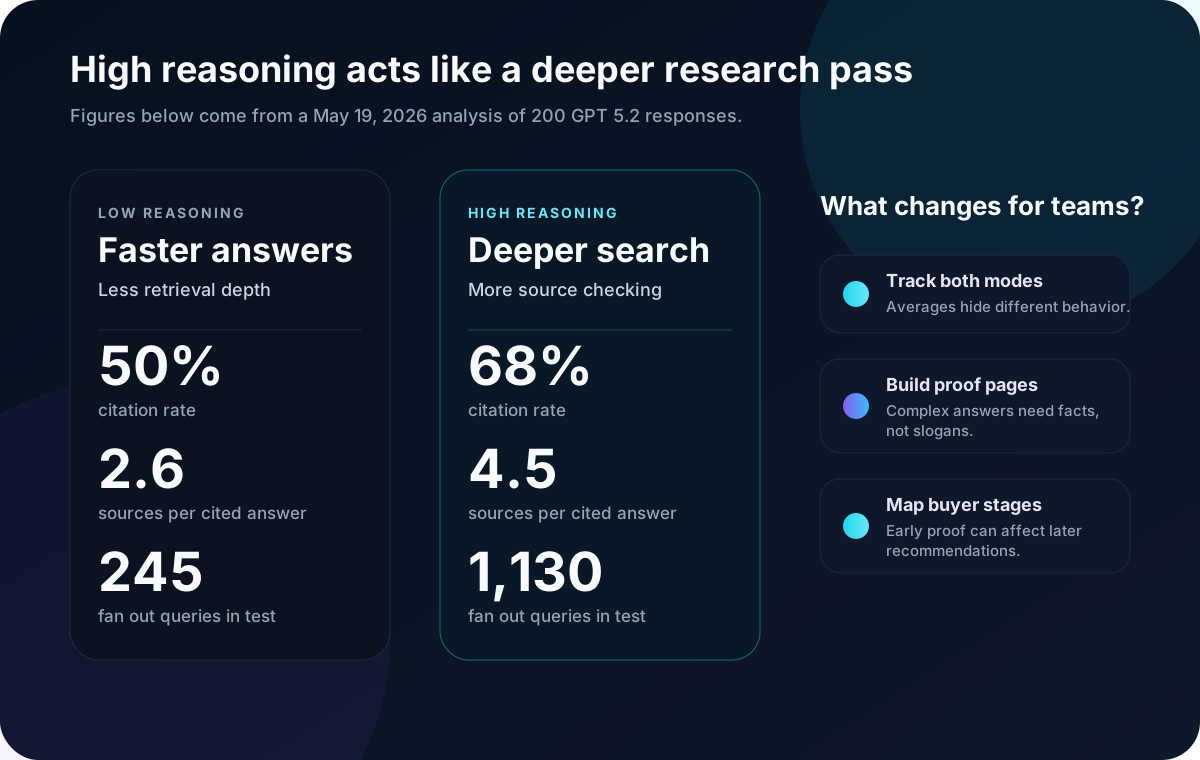
A May 19, 2026 Search Engine Land analysis looked at 200 GPT 5.2 responses across 20 buyer journeys. The test compared low reasoning and high reasoning runs. In that sample, high reasoning increased citation rate from 50 percent to 68 percent, raised average sources per cited answer from 2.6 to 4.5, and increased fan out queries from 245 to 1,130 across the prompt set.
The sample does not establish how every AI system behaves. It does show why a blended visibility average can obscure different behavior: one answer draws on light retrieval or memory, while another searches more widely for evidence on smaller questions.
Why do harder AI questions cite different sources?
Harder AI questions cite different sources because the model may break the question into smaller evidence needs. A buyer does not only ask "who is best." They ask who fits the budget, which provider handles their use case, what the risks are, what current customers say, what the setup looks like, and what happens if something breaks.
Google has described AI Mode as using query fan out to issue multiple related searches across subtopics and data sources. In business terms, one buyer prompt can become a bundle of hidden research tasks. A page that answers only the top level question may not satisfy the sub questions that decide the final answer.
This is where old SEO habits can mislead teams. It is tempting to write one broad guide and hope it ranks. But an AI answer may need a support page, a pricing explanation, a technical doc, a case study, a comparison page, a review profile, and a current directory record before it can trust the brand for a detailed recommendation.
| Buyer question | Fast answer may use | High reasoning may check | Business action |
|---|---|---|---|
| What does this category mean? | A broad explainer and known entities. | Definitions, current examples, and source agreement. | Publish a clear answer page with cited proof. |
| Which option fits my team? | Common brand names and short summaries. | Use cases, constraints, pricing, docs, and reviews. | Build use case pages with real limits. |
| Can I trust this vendor? | Website claims and general reputation. | Case studies, security pages, policies, and outside proof. | Align claims across owned and outside sources. |
| What should I do next? | A generic checklist. | Step order, tradeoffs, risks, and implementation details. | Give the model a practical workflow to cite. |
How should teams track low and high reasoning separately?
Track them as two related systems, not one blended score. Use the same prompt set, the same buyer stages, and the same scoring fields. Then run quick answer tests and deeper reasoning tests separately. Record citations, brand mentions, cited page types, source freshness, and whether a brand appears across more than one stage of the journey.
This matters most for complex decisions. B2B software, financial products, medical services, legal services, high ticket ecommerce, education, travel, and technical buying journeys all have questions where the user leaves room for the AI to research. A simple prompt can hide those differences. A staged buyer journey exposes them.
Look for repeated patterns across prompts and buyer stages. Model, mode, location, prior context, tools, and freshness can change an individual answer. Record which questions earn citations and which types of source recur, rather than declaring a win from one response.

What proof helps a brand survive deeper reasoning?
Deeper reasoning needs proof that can stand alone. Start with owned pages that explain the category, use case, implementation method, limits, pricing logic, policies, security posture, product data, support paths, and real outcomes. Then make sure outside sources do not contradict those facts.
For a software company, useful corroboration can include docs, changelogs, security pages, integration directories, review profiles, partner pages, case studies, and public status history. For a service business, it can include current directory profiles, reviews, service area pages, local mentions, proof photos, credentials, and support policies. For ecommerce, it can include product structured data, merchant feeds, policy pages, reviews, support docs, and current stock or fulfillment facts.
The key is consistency. If your homepage says one thing, your help center says another, your directory profiles show old categories, and customers use a different name in reviews, an AI system has to resolve ambiguity. Sometimes it resolves that ambiguity by ignoring you.
Where do SEO, AEO, and GEO fit?
SEO still gives the foundation: crawlable pages, useful content, internal links, performance, clear titles, and structured data that matches the page. AEO makes the answer easy to extract: direct definitions, short explanations, clear steps, and question shaped sections. GEO adds citation readiness: entity clarity, source backed claims, current proof, and outside corroboration.
Google Search Central says success in AI experiences still depends on helpful, original content, crawl access, and structured data that matches visible content. That means reasoning mode AI visibility is not a reason to abandon normal search discipline. It is a reason to make your proof more complete.
A good page should answer the main question quickly, then support the deeper questions nearby. If the model extracts only one section, that section should still make sense. If the model fans out into a related question, your site should have a relevant page, document, or proof point that handles it directly.
What does this look like for a real business?
Picture a founder shopping for an AI automation partner. A quick answer may name familiar categories and give broad selection advice. A deeper answer may check whether the vendor has implementation examples, technical docs, security language, review signals, pricing clarity, workflow controls, and proof that the company can handle the founder's specific operating problem.
If the site only says "we build AI agents," the deeper answer has little to work with. If the site explains real workflows, risk tiers, data access, review gates, examples, measurable outcomes, and tradeoffs, the answer has stronger source material. If third party mentions and customer language support the same facts, the citation environment gets stronger.
The same pattern applies to a local service company, ecommerce brand, agency, or product team. A deeper AI answer is usually trying to reduce uncertainty. The brand that reduces uncertainty with clear proof has a better chance of being named in the final recommendation.
What should business leaders do this quarter?
Start with ten prompts that match your real buyer journey. Include problem questions, exploration questions, comparison questions, validation questions, and selection questions. Run them in a quick answer setting and a deeper reasoning setting where the tool supports that. Log the cited domains, cited pages, brand mentions, answer claims, and missing proof.
Then map the gaps. If the model asks sub questions your site does not answer, create or improve the right page. If it cites a third party with outdated facts, fix the public record where you can. If your own pages contradict each other, align them before writing more content. If a page gets cited early but disappears later, inspect the later stage proof gap.
Keep the review loop practical. Update proof quarterly, rerun the prompt set, and compare mode behavior over time. Do not promise a ranking or an AI citation. Build a public evidence base that makes the right answer easier to support.
Where Deploy Agentic fits
Deploy Agentic helps teams turn AI search and automation ideas into working systems with clean data, useful evaluation loops, and human review. For reasoning mode AI visibility, that means building the prompt set, logging answer evidence, mapping source gaps, and turning those gaps into practical content, data, and workflow fixes.
For related reading, see the Deploy Agentic blog, the guide to AI visibility ROI measurement, the Google AI Search AEO and GEO article, and the AI SEO audit agent article. The ecosystem section explains the broader operating model, and the contact page is the clean next step when you want to map your own visibility test.
FAQ
What is reasoning mode AI visibility?
Reasoning mode AI visibility is the way a brand appears when an AI system spends more effort on a complex question, runs more retrieval steps, checks more sources, and builds a more detailed answer.
Why can high reasoning answers cite different sources?
High reasoning answers can cite different sources because the model may break one question into many sub questions, search across more evidence, and weigh source authority differently from a faster answer.
How should teams measure AI visibility across reasoning modes?
Teams should track low and high reasoning prompts separately, group prompts by buyer stage, record cited domains and brand mentions, and compare which pages survive from early research questions into final selection questions.
Bottom line
Test whether your evidence answers the harder version of the buyer's question. Improve the pages and sources that leave gaps, keep public facts current, and compare quick answers with deeper research over time.
Sources
- Search Engine Land, May 19, 2026: Reasoning lift and brand visibility analysis
- OpenAI, August 7, 2025: GPT 5 reasoning effort for developers
- Google, May 20, 2025: AI Mode in Google Search and query fan out
- Google Search Central, May 21, 2025: Succeeding in AI search experiences
- Google Search Central, updated December 10, 2025: Guidance on generative AI content
- NIST AI Risk Management Framework
- Schema.org: Article type
- Schema.org: FAQPage type
Test the harder buyer questions
Pick your real buyer journey, run quick and deep answer tests, and turn the missing proof into pages, data, reviews, docs, and public facts an AI system can trust.
Map the visibility test