
AI assisted content should be judged like any other business asset: is it true, useful, reviewed, and backed by proof?
- AI content quality audit
- AI content review
- AI generated content
- content provenance
- answer engine optimization
Teams are publishing faster with AI. The review system has to improve just as quickly.
Better AI-assisted content starts with the review process, not a clever prompt. AI can outline, summarize sources, find gaps, and prepare drafts. A responsible person still owns customer and legal claims, product promises, dates, prices, and proof.
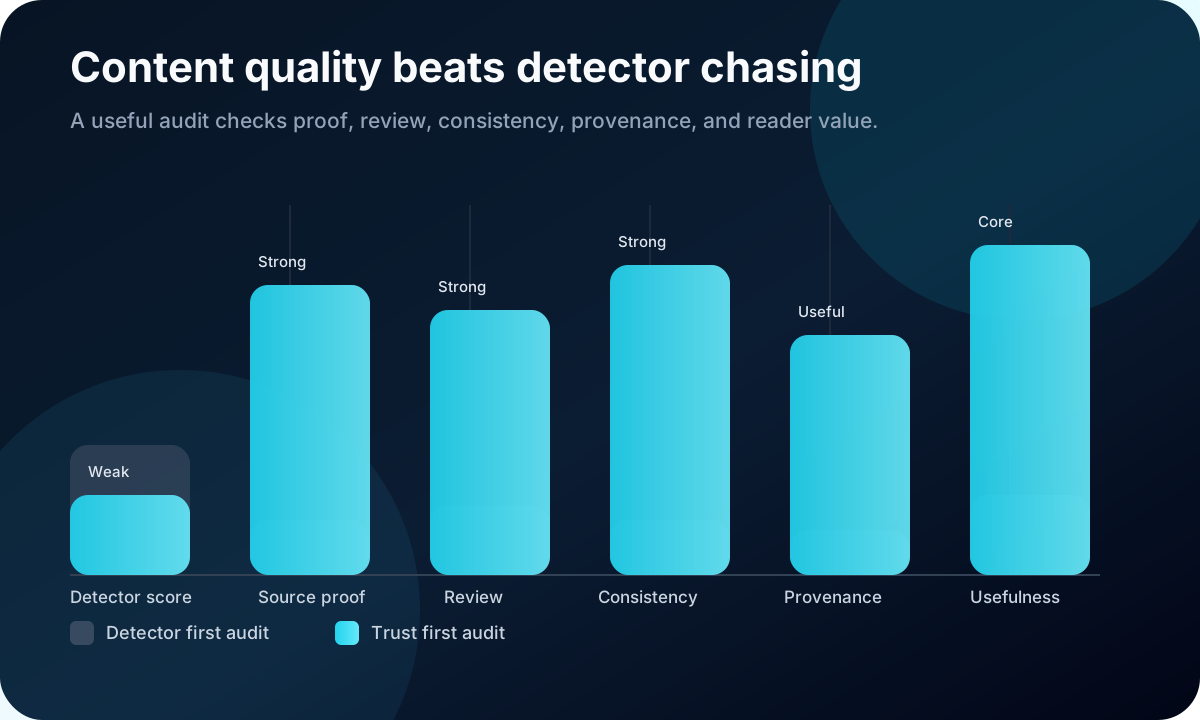
A detector score cannot answer those questions. A useful audit identifies who checked the facts, what changed since the source was published, whether the page agrees with other public evidence, and whether the reader receives more value than a generic summary.
What is an AI content quality audit?
An AI content quality audit checks whether AI-assisted content is useful, accurate, source-backed, reviewed, and consistent with public facts. It is a publishing control for teams using AI in blogs, support pages, documentation, sales material, product pages, social posts, and knowledge bases—not a search for phrasing that fools a detector.
The audit should answer five questions before publication. Is the page useful to the buyer or customer? Are the claims supported by current sources? Did a responsible person review it? Does it match the company facts shown on other owned and independent pages? Can search engines and AI systems extract the answer without confusion?
That last question matters for SEO, AEO, and GEO. Strong Google rankings do not guarantee AI visibility, and polished generic text does not create it. Clear entities, current proof, crawlable pages, consistent public facts, and genuinely useful source material give a page a better case.
Should businesses rely on AI content detectors?
Businesses should not rely on AI content detectors as a publishing gate. A detector can point to a possible review issue, but it cannot prove whether a page is accurate, useful, legal, original, or safe to publish. Treat it like a smoke alarm with a bad sensor. Look into the signal, but do not let it run the building.
Stanford HAI reported on research showing that seven popular detectors incorrectly classified an average of 61.3 percent of TOEFL essays written by Chinese students as AI generated, while 97.8 percent of those essays were flagged by at least one detector. That is a serious warning for any team that wants fair review standards. Direct, simple writing is not proof of machine authorship.
Do not ask writers to add noise, awkward phrasing, or fake imperfections. Spend that review time on facts, source quality, customer language, examples, tone, and the consequences of getting a claim wrong.
Does Google ban AI generated content?
Google does not ban AI generated content just because AI was used. Its February 8, 2023 Search Central guidance said appropriate use of AI or automation is not against its guidelines. The issue is purpose and quality. Automation used mainly to manipulate search rankings is a spam problem. Helpful, reliable, people first content is the target.
That distinction is useful for business teams. The risk is not the mere presence of AI in the workflow. The risk is thin pages, copied summaries, invented evidence, outdated claims, weak expertise, scaled pages that do not help anyone, and content that exists only to catch traffic.
Google also calls out scaled content abuse in its spam policies. The important phrase is not "AI" by itself. The important idea is producing many pages mainly to manipulate rankings and failing to help users. A human can create that problem too. AI just makes it faster.
What should an AI content audit actually check?
Check the work behind the published page: where the claim came from, who reviewed it, which business facts it depends on, and what supports it elsewhere. Keep the audit simple enough to repeat each week.
| Audit area | What to check | Failure sign | Fix before publishing |
|---|---|---|---|
| Source proof | Dates, primary sources, official docs, real examples, and limits. | The page makes a claim but cannot show where it came from. | Add a source, narrow the claim, or remove the sentence. |
| Human review | A named owner checks accuracy, tone, risk, and customer usefulness. | The draft is approved because it sounds polished. | Assign review ownership and record what was changed. |
| Entity clarity | Company names, product names, categories, locations, policies, and offers. | The page conflicts with support pages, reviews, profiles, or directories. | Align the public facts and keep authentic customer language. |
| Reader value | Specific answer, tradeoffs, proof, next steps, and context. | The page could apply to any brand in the category. | Add real constraints, examples, data, or operating detail. |
| Crawl readiness | Clear headings, readable HTML, structured data, and accessible pages. | The answer is buried, blocked, duplicated, or unclear. | Front load the answer and make the page easy to extract. |
Why does generic AI writing hurt trust and AI visibility?
Generic AI writing creates two problems at once. Readers feel that the page is saying familiar things with no real judgment. AI answer systems also get fewer strong signals to extract because the page lacks specific entities, source backed claims, dates, examples, and clear buyer language.
Florida State University researchers studied why ChatGPT overuses certain words, including "delve," and connected the pattern to training and alignment behavior. The business lesson is not that one word ruins a page. The lesson is that repeated model habits can flatten voice and make public content feel less grounded.
Give the reader a reason to stay. Explain the exception that changes the advice, name the source date, and describe the tradeoff in the words customers use. Cut sentences that add polish without adding information.

How should teams handle provenance and disclosure?
Provenance is becoming a bigger part of content trust, especially for images, audio, and media that may be edited or generated. On May 19, 2026, OpenAI said it was strengthening content provenance with C2PA conformance, SynthID watermarking for images, and a public verification preview for OpenAI generated media. The same post also said no detection method is foolproof.
C2PA standards are designed to help certify the source and history of media through technical metadata and related specifications. For business teams, that means provenance should be treated as one trust layer, not the whole trust system. Metadata can help. Watermarks can help. Editorial records still matter.
A practical content workflow should keep source links, original files, prompt context when it is relevant, reviewer notes, publication dates, and change history. You do not need to dump internal process onto every public page. You do need enough internal evidence to explain how the page was made, reviewed, and updated.
What does this look like in a real business workflow?
Consider an ecommerce buying guide. AI can gather common questions, compare use cases, and propose an outline. That gives the team a draft to inspect; it leaves the product and editorial checks below unfinished.
A merchandiser checks product facts, stock language, return policy, and feature claims. A marketer checks whether the intro answers a real buyer question instead of opening with soft filler. A support lead checks whether the advice matches what customers ask after purchase. A technical reviewer checks structured data and crawl access. The final page includes sources where claims need support and avoids promises the business cannot keep.
Now imagine the same process for a service business. The team can use AI to build a local service guide, but the audit should check licensing language, location facts, service boundaries, customer examples, review language, directory consistency, and support policy. A generic post will not build trust. A reviewed page with real facts can.
How does an audit improve AEO and GEO?
An audit improves AEO and GEO because it makes the answer easier to trust and extract. Answer engines and generative engines need clear entities, direct answers, citation ready sections, and consistent facts across the public web. A content page that is accurate only on its own domain is still weak if reviews, directories, docs, and support pages tell a different story.
The citation environment matters. For a software company, independent source types may include product docs, help centers, review sites, partner pages, security pages, changelogs, case studies, and developer references. For a local service business, they may include Google Business Profile, local directories, customer reviews, trade associations, local press, and support pages. For an ecommerce brand, they may include product structured data, merchant feeds, policy pages, reviews, marketplace listings, and buyer guides.
Inconsistent claims create ambiguity. If a page says the company serves one audience, reviews say another, and directories list old locations or outdated categories, an AI tool has to guess. The audit should catch those conflicts before content work becomes a larger visibility problem.
What should business leaders do this quarter?
Start with the twenty public pages that buyers, customers, or AI tools are most likely to use: service pages, product pages, support pages, pricing pages, comparison pages, category guides, and high traffic blog posts. Do not start by rewriting everything. Start by scoring the pages.
Give each page a simple score for source proof, human review, entity clarity, public consistency, crawl readiness, and usefulness. Fix the pages where weak claims touch revenue, trust, legal risk, customer service, or AI visibility. Then build the same checklist into the publishing process so new content does not create the same problem again.
NIST's AI Risk Management Framework and its Generative AI Profile both point teams toward governance, mapping, measuring, and managing AI risk. Content teams can apply the same habit at a practical level. Map where AI touches the workflow. Measure the quality signals. Manage the risks before the page becomes public proof.
Where Deploy Agentic fits
Deploy Agentic helps teams turn AI content and automation ideas into working systems with review gates, source records, technical structure, and measurement. If you are using AI to publish faster, start with the ecosystem view, review the engineering approach, and use the contact page when you want help building a repeatable audit.
For related reading, see the Deploy Agentic blog, the guide to AI visibility strategy, and the Google AI Search AEO and GEO article.
FAQ
What is an AI content quality audit?
An AI content quality audit checks whether AI assisted content is useful, accurate, source backed, reviewed by a responsible person, consistent with public facts, and ready to be crawled or cited.
Should businesses rely on AI content detectors?
No. Detectors can be a weak signal, but they should not decide whether content is publishable. Teams should review facts, proof, author judgment, originality, public consistency, and customer usefulness.
Does Google ban AI generated content?
Google says appropriate use of AI is not against its guidelines, but using automation mainly to manipulate search ranking violates spam policies. The practical standard is helpful, reliable, people first content.
Sources
- Google Search Central, February 8, 2023: Guidance about AI generated content
- Google Search Central: Creating helpful, reliable, people first content
- Google Search Central: Spam policies for Google Web Search
- Stanford HAI, July 11, 2023: AI detectors biased against non native English writers
- Florida State University News, February 17, 2025: Researchers study repeated AI word patterns
- NIST, AI Risk Management Framework
- NIST AI 600 1, Generative AI Profile
- C2PA Specifications 2.2
- OpenAI, May 19, 2026: Advancing content provenance
Build the audit before the next content sprint
If your team is using AI to publish faster, create the review system now: source proof, owner review, public consistency, provenance records, crawl readiness, and a useful answer on every important page.
Map the content audit