
If agents can buy, businesses need records that show what the agent was allowed to do, what it actually did, and who accepted the risk.
- AI agent purchase disputes
- agentic commerce disputes
- AI agent payment authorization
- agent purchase evidence
- agentic commerce risk
Payment networks and protocols are moving fast. Many merchant support, policy, and evidence systems are still built for a human clicking buy.
The important question in an AI purchase dispute is not which protocol handled the order. It is what the business can prove when the buyer says, “That is not what I meant.”
A receipt is only the end of the trail. The business also needs the buyer's instruction and limits, the offer shown to the agent, proof of payment authority, the fulfillment record, and a support path after the order.
What are AI agent purchase disputes?
AI agent purchase disputes are disagreements over agent driven buying. They can happen when a buyer claims the agent was not allowed to buy, bought the wrong thing, missed a condition, misunderstood a policy, repeated an order, or paid a price the buyer would not have approved.
Agent purchases need a stronger evidence trail than normal checkout. A human session compresses the proof: the buyer sees the product and cart, clicks the button, and receives confirmation. Agent commerce divides that moment into several steps across several systems.
OpenAI and Stripe made this split public in September 2025 with Instant Checkout and the Agentic Commerce Protocol. Google then framed the deeper payment issue through AP2, where the proof trail is built around intent and cart mandates. Visa, Mastercard, banks, and payment trade groups are now working through the same basic problem: how do you prove an agent had authority to act?
Why do AI agent purchases create new dispute risk?
AI agent purchases create new dispute risk because the person who owns the money may not be present at the exact moment the agent chooses, confirms, or pays. The agent may be following old instructions, partial instructions, or a goal that sounds simple until real world conditions show up.
A buyer might tell an agent to find the best hotel under a budget. The agent may book a room that fits the price but has a strict cancellation policy. A purchasing agent may renew software that fits the team size but violates an internal vendor rule. A shopping agent may choose a product that matches the prompt but conflicts with a delivery deadline, warranty need, or return expectation.
Payment systems were not designed around those gray areas. The Consumer Financial Protection Bureau describes error resolution and unauthorized transfer rules for electronic fund transfers, but agent delegation creates harder factual questions. The Consumer Bankers Association's January 2026 paper made the point plainly: existing consumer protection rules helped digital payments scale, but their application to agentic payments is uncertain in some cases.
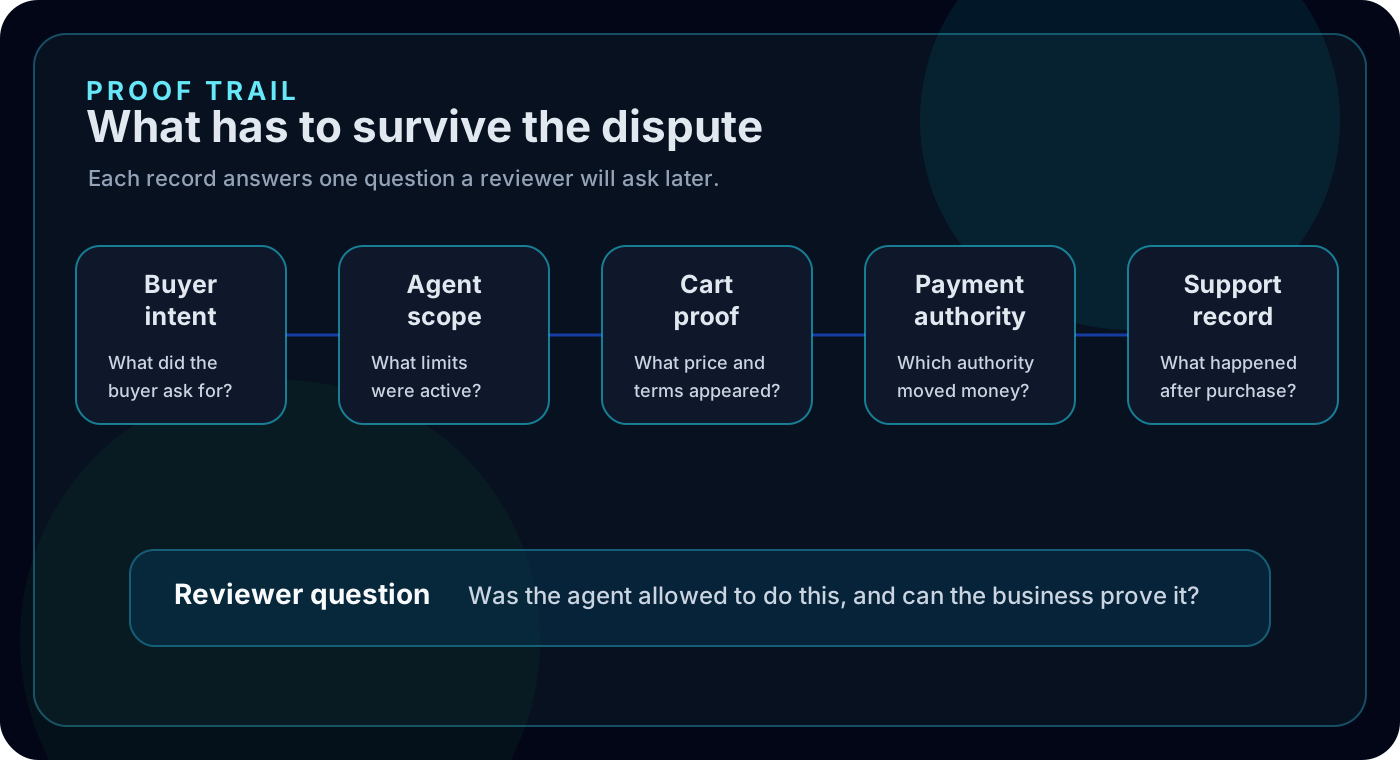
What proof should a business keep before an AI agent buys?
Keep the records that connect the buyer's instruction to the agent's action and the final order. Support, risk, finance, and bank reviewers need a usable chain of evidence, not an indiscriminate pile of logs.
The minimum useful record has eight parts. Keep the buyer intent, the agent or platform identity, the permission scope, the cart and price snapshot, the product and policy details shown at the time, the payment authority, the fulfillment record, and the support history. If a human approved the purchase, keep that approval. If the agent acted without a human present, keep the rule that allowed it.
This is where many businesses will find the gap. They may have a payment record, an order record, and a shipping record, but not the instruction that created the order. They may know the customer bought something, but not whether the agent was told to avoid a certain size, vendor, delivery window, cancellation rule, or subscription term.
How do AP2 mandates change the evidence model?
Google's AP2 changes the evidence model by treating the instruction and the cart as records that can travel with the transaction. Google describes mandates as tamper resistant digital contracts that serve as verifiable proof of a user's instructions.
That matters because the dispute question moves upstream. Instead of asking only whether the card was charged, the business can ask whether the agent stayed inside the buyer's instructions. For a human present purchase, AP2 describes an intent mandate followed by a cart mandate. For a delegated task, the user signs the intent upfront with rules such as price limits, timing, and conditions.
The practical lesson is bigger than one protocol. Any business preparing for agent purchases should make its own version of that proof chain visible in operations. If the business cannot answer what the buyer authorized, what the agent saw, what changed before payment, and what system accepted the order, it is not ready for high volume agent buying.
What are payment networks and banks already signaling?
Payment networks and banks are signaling that agent commerce will need visible agent identity, scoped credentials, user control, fraud checks, and faster dispute clarity. The public announcements are not just launch news. They show the shape of the evidence stack.
Stripe's September 2025 announcement says its shared payment token is scoped to a specific merchant and cart total, and that orders flow to the merchant backend for acceptance, tax, fulfillment, returns, and support. That keeps the merchant in the record chain instead of turning the agent surface into a black box.
Mastercard announced live controlled agent payment transactions in March 2026, including a Santander pilot in Europe and transactions across Latin America and the Caribbean. Mastercard described agentic tokens, biometric authentication, traceability, fraud protections, visible agent participation, and verifiable intent as part of the payment flow.
Visa expanded its Agentic Ready program on April 29, 2026. Visa described the need to prepare for agent led commerce where AI agents move from answering questions to searching, deciding, and paying. Its materials repeatedly come back to tokens, identity, risk, controls, authentication, and spend limits.
The announcements point toward an evidence chain around the purchase: identifiable agents, limited credentials, buyer approval, and records a reviewer can inspect.

How should merchants prepare support and return teams?
Merchants should prepare support and return teams by giving them a plain view of agent purchase evidence. A support agent should not need to guess whether an AI agent ordered the item, what policy was shown, or whether a buyer gave delegated authority.
Start with the support screen. Add fields that show whether the order came through an agent channel, what agent or platform submitted it, what product data was sent, what price and terms were captured, and whether a human approval step happened. If the system cannot show that yet, create a temporary internal tag and a manual evidence checklist before agent orders become common.
Next, review the policy pages that agents may read. Shipping, returns, warranty, cancellation, trial, subscription, and refund rules need plain language and stable URLs. Do not hide the real rules in a checkout modal only a human can see. If an agent cannot access the policy, the business may struggle to prove the buyer or agent had fair notice.
How does this connect to AI visibility and citation readiness?
AI visibility and dispute readiness meet at the same place: clear public proof. A business that wants AI tools to recommend, cite, or transact with it needs consistent entity details, crawlable pages, structured data that matches visible content, and current policy pages that outside systems can understand.
Strong Google SEO does not guarantee AI visibility. It also does not guarantee an agent can safely buy. The public record needs to answer practical questions that an AI system or a human reviewer can reuse: who sells the product, what is included, what conditions apply, what happens after purchase, and how disputes are handled.
Use Article, Organization, Product, FAQ, and policy related structured data where it reflects visible page content. Keep the sitemap current. Make important pages accessible to the AI crawlers and search systems the business cares about. Test llms.txt as a guide for AI systems if it fits the site, but do not treat it as a substitute for crawlable, accurate pages.
Contradictory claims create ambiguity. If the product page says one return rule, a marketplace profile says another, reviews complain about a different expectation, and support docs are stale, AI systems and dispute reviewers have a messy record. Align public content with authentic customer and review language instead of forcing polished brand language that no buyer uses.
What sources will AI tools trust for agent commerce claims?
AI tools are likely to trust official protocol docs, payment network pages, bank or issuer guidance, merchant policy pages, developer docs, product pages, customer reviews, support articles, credible case studies, and current industry or standards body material. The mix depends on the category.
For agent payments, an answer engine may lean on Google AP2 docs, OpenAI and Stripe commerce docs, Visa and Mastercard materials, CFPB or other regulator pages, NIST standards work, OWASP security guidance, and well maintained merchant documentation. For a retail buyer question, it may also use reviews, directories, marketplace profiles, and public support pages.
Community discussions are useful as research because they show the language real people use when they are worried. People rarely ask for "delegated authorization architecture." They ask who pays when the agent messes up, whether a bot can be trusted with a card, and how a merchant proves the order was real. Use that language to shape public answers, then support it with credible sources.
How should businesses refresh agent commerce proof?
Businesses should refresh agent commerce proof at least quarterly because protocols, payment support, crawler behavior, and buyer expectations are moving quickly. A static policy page from last year will not be enough if agent orders become material.
A practical quarterly review checks five things. First, confirm which agent channels and payment rails are live or planned. Second, update product, policy, and support pages. Third, review structured data, sitemap coverage, robots rules, and AI crawler accessibility. Fourth, compare owned claims against reviews, directories, customer language, and support themes. Fifth, test ten buyer prompts and record which sources AI tools cite when answering questions about the business.
Keep the public record current and check it against independent sources. Consistent product and policy information gives both a buyer and a dispute reviewer less ambiguity to resolve.
The AI agent purchase dispute checklist
Use this checklist before enabling agent orders at scale.
- Record the buyer's instruction or delegated task in a retrievable format.
- Capture the agent, platform, channel, and account that submitted the order.
- Store the permission scope, including price, time, vendor, item, and policy limits.
- Save the cart, price, tax, shipping, and availability snapshot used for the order.
- Keep the product, warranty, subscription, cancellation, and return terms shown at the time.
- Use scoped payment credentials or tokens where available.
- Log whether a human approved the final cart or whether the agent acted under prior rules.
- Mark agent orders clearly in support, finance, fulfillment, and fraud tools.
- Give support teams a one screen view of the evidence trail.
- Refresh public policy pages and structured data at least quarterly.
FAQ
Is an AI agent purchase dispute just a normal chargeback?
No. It may become a chargeback, but the root issue can be broader. The dispute may involve the buyer's instruction, the agent's interpretation, the merchant's product data, the platform's payment flow, or the bank's view of authorization.
Do merchants need a new policy page for AI agent orders?
Not always. Many businesses can start by making existing shipping, return, warranty, subscription, and support pages clearer, crawlable, current, and easier to cite. If agent orders have special terms, those terms should be public and easy to find.
Can structured data prove authorization?
No. Structured data can clarify products, policies, organization details, and page meaning. It does not prove that a buyer authorized an agent purchase. Authorization needs its own record, such as a mandate, token, approval log, or permission event.
Should businesses block AI agents until the rules are settled?
Some high risk categories may need a slower rollout. For many businesses, the better first step is to accept agent traffic and agent referrals carefully, then require human confirmation or scoped payment authority before a purchase completes.
Bottom line
Build the case file before you need it. Link buyer intent, permission scope, payment, fulfillment, support, and the policy shown at purchase so a reviewer can follow the order from start to finish.
Businesses should prepare now while volumes are still manageable. The practical work is not glamorous: cleaner records, clearer policies, safer tokens, better support screens, crawlable proof, and a quarterly habit of checking whether the public record still matches reality.
Sources
- OpenAI, September 29, 2025: Instant Checkout and Agentic Commerce Protocol
- Stripe, September 29, 2025: Instant Checkout in ChatGPT and Agentic Commerce Protocol
- Google Cloud, September 17, 2025: Agent Payments Protocol
- Visa, April 29, 2026: global expansion of Agentic Ready
- Mastercard, March 2, 2026: Santander and Mastercard agent payment pilot
- Mastercard, March 24, 2026: live agentic payment transactions in Latin America and the Caribbean
- Consumer Bankers Association, January 22, 2026: Agentic AI payments white paper
- Consumer Financial Protection Bureau: Electronic Fund Transfers FAQs
- NIST, updated April 20, 2026: AI Agent Standards Initiative
- OWASP GenAI Security Project, December 2025: Top 10 for Agentic Applications
- Schema.org: Article type
- Schema.org: FAQPage type
If agents can buy from you, your proof trail needs to be ready before the first dispute.
Deploy Agentic helps business teams make agent commerce practical: crawlable policies, structured proof, support evidence, source mapping, and operating checks that keep the public record aligned with reality.
Talk With Deploy Agentic